

Keeping the Light
On the resonance of war, public discourse, and being relentless

I wasn’t going to write another post about the war, to be honest. I don’t plan to make it a habit, so if this is tiring or too much, feel free to skip it. I get it, I am tired of it all, too. Next time I’ll write about Japan! Probably. But in the meantime, every time I sit down to write, this is what comes out. Drafts of this post keep composing themselves in my head when I cannot sleep, which is often these days. Maybe someone, somewhere, needs to hear this. Maybe everyone needs to hear this, but just a few will. That is fine. On the eve of the first day of Hanukkah, I think it is all the more pertinent to look at the gathering darkness, and to know that it must contain the seeds of light.
And light is something we desperately need right now. From the first days, I could feel something about this war—this specific conflict, this global response to it—was very different. Different not only in the scope and intensity of hatred directed towards Israel and Jews, the rise in antisemitic hate crimes, the vitriol in social media, but also in how extensively the general public seems to be misinformed about Israel, its society, history, or the place of Jewish people in the Middle East as such. I know many of my compatriots would disagree, but I’m not about to take on the role of “Jewish educator” just because I myself am Jewish and Israeli. Frankly, I don’t have the skills, stamina, or emotional resilience for making tiktoks for the earnest but ill-informed and for tilting against internet trolls. Besides, leftist, liberal outlets such as the Tel Aviv Institute do it much better than I alone could, and their Instagram is actually a treasure trove of educational materials. I am deeply thankful for such resources.
As someone who is keenly interested in language, in and in the ways we language the world around us, I am going to point out a few of the things that I find particularly baffling, troubling, and downright disturbing in the current public conversation.
To clarify, this is not a wholesale defence of the Israeli government, nor is it a blanket defence of the way the war is going. I’m not a politician or a military specialist, and all war always looks equally horrible to me. People die and suffer; lives are broken. There are no clear heroes and villains, as in the movies or in video games. No triumphant tune plays in the ether after a battle. (The very fact that I feel compelled to say this, lest people jump to wild assumptions, is in itself an alarming indicator of the current state of public discourse—but that’s another conversation entirely.) This is not apologia for war, but a call for sanity. For acknowledging the complexity of the situation, the humanity of all those involved, and also for taking a hard look at some truly troubling trends and what they bode for our future as a society.
Indeed, perhaps for the first time in my life, I am concerned for my safety for simply being being of a certain ethnicity, for speaking a certain language. Sure, I worry about safety as a woman, at times; but never did I feel so racialized as I have in the past two months. I hate this feeling, frankly. I wasn’t taught to feel sorry for myself, and so even when I have encountered prejudice and injustice before, which wasn’t often but did happen, I felt defiant, not afraid. What changed?
Let me see if I can untangle it.
Dark Times
It’s been two months since the Hamas attacks of October 7th, in which armed fighters invaded Israeli towns, burst into homes, and committed untold atrocities—much of it captured by the perpetrators on video (CW: the links in this post are mostly to news articles; some contain extremely disturbing details). The attack left more than 1400 civilians dead, 3300 injured, and 240 more abducted—including infants and children. Some of these hostages were recently returned (swapped for Palestinian prisoners serving time in Israeli jails, many for violent crimes); other hostages are dead, and others yet are still unaccounted for. Notably, ceasefire negotiations broke down the previous Monday when Hamas could not or would not release the agreed-upon number of the abducted women still held captive; some speculate they simply could not find them, others that they wished to “keep some” as a future “bargaining chip.” The savagery of Hamas toward women in particular is beyond description. Accounts—and evidence—of the sexual violence perpetrated by Hamas operatives on October 7th are so grisly, I will admit I am only able to skim the reports. Other details emerging now of how the released hostages were treated, including the children, are likewise shocking for their cruelty and utter dehumanization of the victims.
The media cycle, however, at least here in North America, is largely focused on the situation in Gaza. To some extent, this is understandable. The theatre of war, the tragedy of displaced civilians caught in the crossfire and the attendant humanitarian crisis, is fresher and so more compelling—or as the journalists say, if it bleeds, it leads. Yet, I have also noticed that the scope and intensity of Israel’s military operation has eclipsed, somehow, any kind of contextual treatment of the conflict—especially the fact that it has two fighting sides, and that they are fighting for very different objectives. Few in the mainstream public discourse are willing to acknowledge the complexity and impossibility of the dilemma faced by Israel, today but also broadly. Jonathan Freedland recently did so, but his op-ed appears to be the exception, sadly; it’s decidedly worth a read.
More likely than not, people simply pick a side. For some it may be a matter of convenience, perception, social circle, identity politics, or whatever seems popular in their friend group. Many appear to pick sides without knowing too much about it—just because they’ve heard something repeated enough times. As one young woman had put it in one of those “real or fake news?” segments I saw circulating recently, “if so many people say that something is wrong, then it must be true.” Iron-clad logic. In the same segment well-dressed, friendly-looking folks in their 20s and 30s claimed that Israel was an apartheid state without being able to give a definition of “apartheid,” or stated confidently that it is committing a genocide without being able to list any of the details—historical and otherwise. They simply held these opinions, as if these are just neutral facts about the world, like what is the capital of Spain and where is the tallest mountain in Africa. Truth, these days, appears to be really just whatever is loudest or gets more shares on social.
To say that it is distressing for me, a Jewish Israeli woman, to see utterly everyday people being so deeply misinformed, and so casual in their judgements, is putting it very, very mildly.
Like many Jews and Israelis on the progressive left, I have experienced successive waves of shock, bewilderment, sadness, anger, and deep disappointed at the public response to the conflict—particularly from folks I considered ideological allies. I don’t mean just the knee-jerk response on university campuses, worrying as it is, or the people who join a demonstration to “support their friends,” chanting eliminationist, genocidal slogans with only the vaguest idea of what or who they are supporting. If in the past university administrators made attempts to curb hate speech, the tide of misinformation and self-righteous, dogmatic “student activism” makes it nearly impossible for dissenting voices to be heard—or even admitted.
Recently, the presidents of Harvard, Penn, and MIT refused to clearly state that calling for the genocide of a people violates their code of conduct, and skirted the questions posed to them using vague ambiguous qualifiers such as “context,” and “conduct.” I know, I know, the congresswoman heading the questioning has a history of antisemitic remarks herself, but this doesn’t make me feel any better to hear president Claudine Gay of MIT, for example, argue that “Antisemitic rhetoric when it crosses into conduct, that amounts to bullying, harassment, intimidation, that is actionable conduct, and we do take action.” A worthy bit of sophistry! Is public rhetoric, namely slogans chanted by a crowd at a rally, somehow not “conduct”? Not “actionable conduct”?? What kind of conduct is President Gay awaiting, precisely? Lynchings?
Such discursive contortions from the top administrators of some of the most elite educational institutions in North America in defence of antisemitism are truly astounding—and deeply troubling. We should be asking ourselves, what social justice activism, in good faith, can tacitly or openly condone acts of violence, ostracism, and discrimination on a “group-belonging” basis? Why are we making exceptions for hate speech, waiting for “actionable conduct”? Universities ought to foster independent thought, curiosity, critical analysis, and healthy (respectful) debate—not abet dogmatic groupthink and cancel culture. If this is the state of discourse in places that ostensibly prioritize free speech, inquiry, and even dissent, what does it bode for the rest of culture?
I’ve heard too many an attempt to excuse all this as “well-meaning but misinformed” or precipitated by an emotional response to the ongoing events. This hardly passes muster. For one, the ignorance argument, lazy as it is, undermines any moral superiority advanced by such activism. And for another, emotionality alone can hardly explain why the same “well-meaning” folks were also going around tearing down posters of missing babies and children, tying themselves into knots trying to divert attention from Hamas atrocities, and even going so far as claiming that—despite overwhelming, ample evidence—that the rapes and the murders are somehow a deep fake by “so-called Israel.”
But that is only part of the problem. Even more alarming, all too many people simply refuse to hold Hamas, the Palestinians who support them, and even other Arab countries directly and indirectly involved in this war as responsible parties. Even people who do not lightly toss about words such as genocide and apartheid, public figures on the left and centre-left who are seemingly reasonable and well-informed, seem to accept the status-quo that whatever situation unfolds in the region, it is Israel’s sole responsibility to find a solution, mitigate a conflict, take initiative, and generally be the adult in the room.
Some are refreshingly honest about the double standard they hold Israel to. Most recently, Rep. Pramila Jayapal, a Democrat for Washington, argued for “balance” in considering Hamas actions, in light of “outrages against Palestinians.” In the same breath as condemning the Hamas rapes, albeit without getting overly emotional about it, Jayapal notes that as a terrorist organization, “of course” Hamas would resort to such tactics; Israel, however, is a democratic state and therefore can be held accountable, must uphold international law, etc. All without skipping a beat. Jayapal points to the 15,000+ Palestinians killed thus far in the conflict as inexcusably high loss of life—and I agree, this is a monstrous toll. Even taking these numbers at face value—they are provided by Gaza’s Hamas-controlled health authority, and do not discriminate between combatants and civilians—given Hamas’s known tactics of operating in heavily populated civilian areas, from under schools and hospitals and mosques, should Hamas not bear at least some of the responsibility here for such outrageous civilian casualties?? Apparently, however, when Hamas claims to not use human shields, we are supposed to simply take their word for it, rather than look at the evidence.
Jayapal calls on us to not perpetuate “hierarchies of oppression,” but, aren’t we already doing that? Why, then, would she divert the question from the utterly horrific violence against Israeli women, brushing it aside, only to engage in yet another morally bankrupt iteration of the “numbers game”?
It goes without saying that any loss of innocent life in war is deeply tragic, and there is no doubt that the humanitarian crisis in Gaza is dire and worsening. Please note that I am not calling for less accountability for Israel; I am calling for more accountability all around. The prevailing double standard which holds Israel alone accountable in any development essentially gives a moral pass to a terrorist regime that pursues a genocidal agenda, and which treats their own population as expendable. A regime which, no matter how successfully it masquerades as a liberation movement, has hardly engaged in any kind of state-building since they took over in 2006. All their efforts, by their own admission and in keeping with their mission statement, have been solely focused on the eradication of Israel.
Arguments for this uneven treatment—both for “overlooking” Hamas violence and for treating Israel as the only responsible party, holding it to a standard no other country is expected to meet—abound. They range from Israel having more firepower, resources, or more powerful allies (all increasingly debatable), to a litany of its policy failures and missteps regarding Palestinians, to, in extreme cases, ahistorical and racist narratives about the place of Jews in the Middle East and the right of Israel to exist. (Some resort to truly outrageous antisemitic tropes, conflating the state of Israel with the “evils of Capitalism,” for example.)
Whatever the rhetoric, it seems that neither Hamas nor any other Palestinian leaders can be held accountable—not for their actions, nor their stance towards Israel, nor even for their administration of Palestinian territories. This philosophy, tacitly accepted by Western nations, has not only hampered any kind of productive and peaceful political solution to the conflicts in the region, but has given groups like Hamas ample freedom to pursue their agendas (hint: it is not Palestinian liberation, at least, not in the form of a peaceful democratic neighbour of Israel).
In contrast, in March of 2023, well before the Hamas attack, the Islamic Fatwa Council issued a statement condemning Hamas for their treatment of Palestinians, calling their actions un-Islamic. The fatwa, which is an official religious censure from one of the highest courts in the Muslim tradition, makes no mention of Israel, as it is irrelevant to the matter at hand. According to the document, the Council reviewed “extensive documentation” of Hamas actions in Gaza at the request of “countless believers,” and concluded that “Hamas bears responsibility for its own reign of corruption and terror against Palestinian civilians within Gaza.”
It seems deeply ironic, not to mention weirdly orientalist, that Western would-be defenders of the oppressed make so little effort to investigate the status of organizations such as Hamas within the Arab status-quo, or to understand it in a broader regional, historical, ideological, and political context.
Instead, calls for a ceasefire continue to be overwhelmingly directed at Israel, as are calls to minimize civilian deaths and damage to civilian infrastructure, while Hamas consistently continues to target civilians, sending hundreds and thousands of rockets into Israeli territory. These near-daily attacks go largely unreported in our media, evident only in the rolling cancellations of flights to Tel Aviv; I find out about them from Israeli media and conversation with friends and family. Just today, my mom was speaking to my uncle on the phone, when he said, “Oh, there goes the siren.” Indeed, the sirens signalling incoming rocket attacks have become daily life, so much so that recently it was decided to change the sounds of emergency vehicle alarms in Israel, so as to cause less confusion and minimize the trauma response for residents.
Similarly, most people I speak with are unaware that border towns close to the Gaza strip such as Sderot and Ashkelon, as well as Kiryat Shmona in the north of Israel have been evacuated almost in their entirety, because the Iron Dome is no longer enough to safeguard them (in the north, the Hezbolla is shelling Israel from Lebanon, in “solidarity” with Hamas, apparently). Even the southern city of Eilat, once considered out of reach of the fracas, is not longer safe, under fire from the Yemeni Houthis. These groups are recognized terrorist organizations, too, so “of course” they are shooting rockets at Israel—using Rep. Jayapal’s logic. Nothing to see here.
Why do these facts of war never seem to make it into our mainstream news coverage here? It is simply because “of course,” that is what they do? Is it because most of the rockets fired by Hamas into Israel are intercepted by the Iron Dome, and so the casualties are minimized? Is it just not enough drama? Would it be “better” if there were more casualties, more destruction? Is that really our threshold for what is wrong and what is right, these days? Whoever has the more dead is justified?
Certainly, Hamas thinks so. They have figured out that this is what works best on a Western public—a public that refuses to hold them accountable, and which vacillates between hailing them as liberators or dismissing any attempt at accountability by saying “but of course, they are a terrorist organization.” Combine this with the West’s two-thousand year long history of antisemitism, and you’ve got yourself a winning strategy: Israel will be held to the standard of international law, criticized for excessive force (any force?), for civilian deaths, for administrative missteps, for policy failings—and Hamas will just do what it does, with zero culpability.
Tragically, and ironically, this imbalance of expectations only serves to further push Israeli politics (especially the current government) to the right, and away from constructive diplomatic solutions. That, in turn, radicalizes sentiment among Palestinians, too, turning the process into a vicious cycle from which most of us see no immediate escape. It is a situation that benefits those who wish to destabilize the region—groups like Hamas, and whoever is funding them—and brings nothing but suffering to civilian populations on both sides. The simple truth is, you cannot tell two fighting sides to “play nice” but only expect one of them to follow through. Kids on the playground know this, and the stakes only get higher as we get older.
Light in the Darkness
Where does that leave us, on the Eve of Hanukkah—a holiday celebrating the triumph of light over darkness and the power of hope, community, and resilience? How we can keep sane and human in these difficult times?
The lesson of Hanukkah is valuable and timely here because it advocates for hope against all odds, for nurturing hope in the most hopeless places; hope not merely despite dire circumstances, but because of them. It is easy to be hopeful and cheerful during the good times; but it is necessary in dark times.
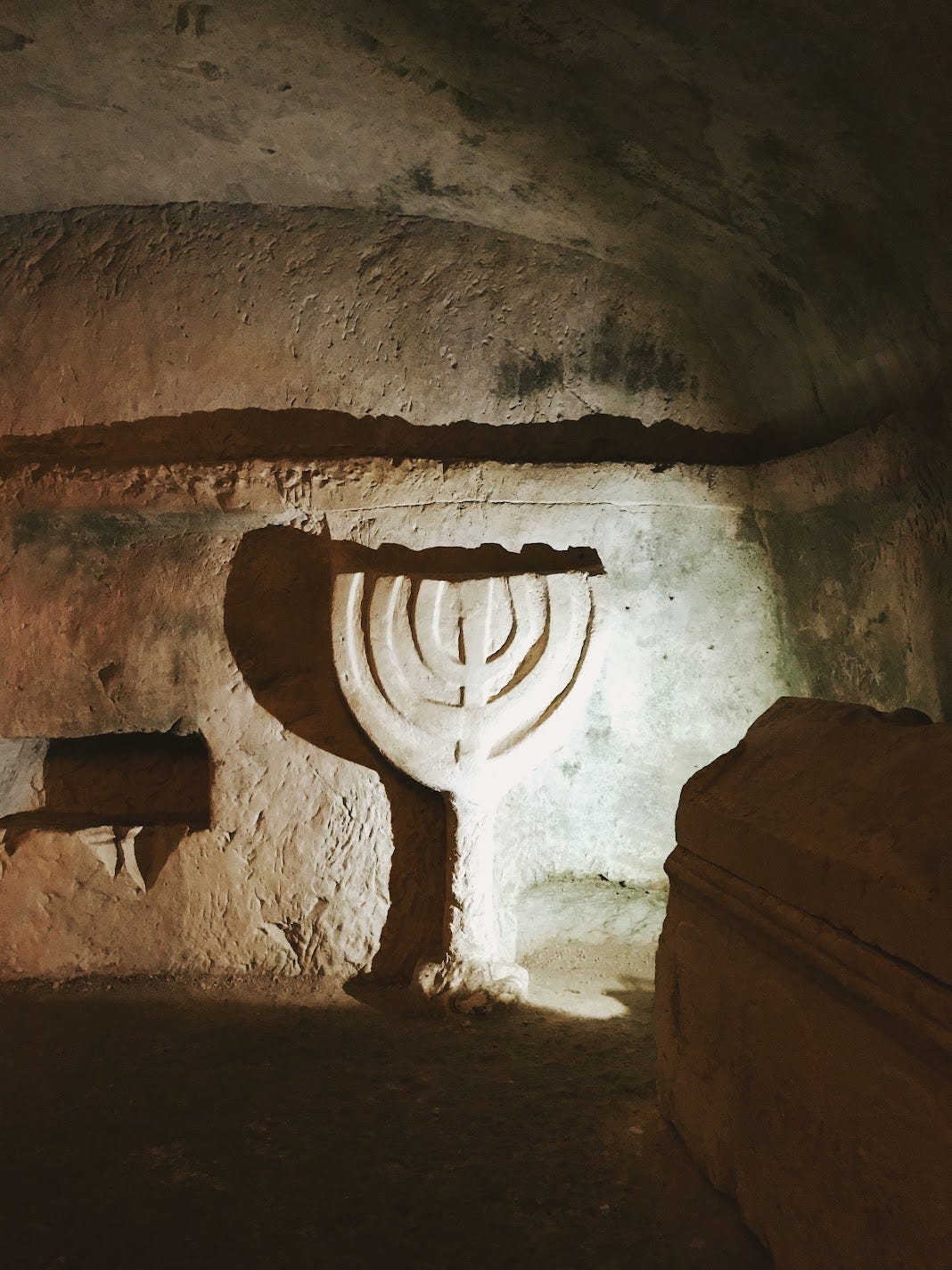
Whatever the historical events that eventually led to the commemoration of the festival of Hanukkah (the wikipedia entry on Maccabees makes for interesting reading), today Jews celebrate it largely for the miracle of a small jug of oil, normally just enough for one day’s lighting the temple menorah, having lasted for eight whole nights—until more oil could be made and consecrated. Hannukah is known as the Festival of Lights, which, besides giving us an excuse to gorge on sufganiyot (delicious oversized jelly donuts), reminds us to remain relentless. To go forth, even when resources seem scarce, when chances of success are slim, when the options before us appear to dwindle. It is supposed to remind us that after darkness comes light, and that we should not doubt our ability to persevere.
Relentlessness, these days, need not be necessarily martial. Being relentless also means not giving in to despair, it means keeping a flame of optimism for the future—even if such optimism seems irrational. Perhaps especially as an irrational kind of optimism. It may seem strange, after everything I have listed above, to advocate for optimism—but when if not now? Or rather, in the words of Hillel the Elder, a Jewish scholar living in the 1st century BCE famous for his pithy aphorisms, “If I am not for myself, who will be for me? And if not now, when?” It might sound like a lot of responsibility, to maintain this relentless inner resilience, but how can we support one another, when we have given in to rage and despondency? In a sense, it is the only way forward.
This is why now, of all times, it is important to protect one’s time, regulate one’s intake of information, keep a healthy daily routine, and attend to the little joyful things that fuel our lives. It sounds paltry, but it is no small feat in the current climate. Words—the narratives and symbols we immerse ourselves in—have power over our minds, our moods, and consequently our actions. This doesn’t mean we can remain ignorant or uninformed, but being informed is not the same as following every news update obsessively, as hard as it may be to disengage.
This seems self-evident, but I know for many of us it isn’t. Survivor’s guilt is real, and so is the guilt of living in relative safety, away from the war and the violence, especially if people you care about do not have that luxury. I struggle with all this myself, but ultimately, I realized there is little use of driving oneself to emotional and mental burnout.
In the darkest times, it is worth recalling what makes life good. This is not a betrayal of the fallen; not a desecration of the suffering. One must be able to imagine some day in the future when the conflict is resolved, when the dead are grieved, when the wounds are healed, when new seeds of future joy have been planted and blossomed.
To be able to think about the future—to imagine a future that is peaceful, safe, and abundant for all, and to work towards it—we have to have something good to hang onto in the present, too.
The good things are often small—like a measly pot of oil—and they seem dwarfed by the awful things. But they can take us surprisingly far. The purr of the cat, the comfort of a home-cooked meal, the affection of one’s loved ones, the warmth of friendly conversation, the way the light falls in the afternoons, the beauty of some timeless work of art, the satisfaction of a task accomplished. These are not only bulwarks against the darkness, but these small things illuminate our own humanity, not letting us forget what is truly important. May we remember it, always.
Nika- Thank you for sharing this during what must be an impossibly confronting time. Nothing that I say can possibly help you in anyway except that I appreciate your open insight on light, war, life, and everything in between.